Hotline: +84983158979
No. 217/2A1 Xo Viet Nghe Tinh St., Qtr. 62, Gia Dinh W., HCMC, Vietnam
Recognition of foreign qualifications is a common need among international graduates, overseas-trained workers, and businesses recruiting highly qualified personnel. Without completing this procedure, your qualification may not be accepted when applying for a job, taking a civil-service examination, or pursuing further education in Vietnam.
This article provides a comprehensive guide to the process, required documents, processing time, and support services for obtaining the lawful and timely recognition of foreign qualifications under Circular No. 13/2021/TT-BGDDT, effective from June 1, 2021.
Recognition of a foreign qualification is the process by which a competent Vietnamese authority confirms the legal value of a qualification issued by a foreign educational institution. This is an important step that allows the qualification holder to use the document for further study, employment, salary assessment, appointment, or participation in examinations in Vietnam. The procedure also helps identify fraudulent qualifications and protect learners' rights.
Recognition of a qualification issued by a foreign educational institution for use in Vietnam- hereinafter referred to as "qualification recognition"- means recognizing the holder's education level stated on the qualification under the education system of the country where the foreign educational institution is headquartered and determining its equivalence to a level specified in the Vietnam National Qualifications Framework.
There are two main cases involving recognition procedures for qualifications at university level or higher:
Vietnamese citizens who studied directly at a university abroad.
Vietnamese citizens who completed a university program delivered through a joint training arrangement between Vietnam and a foreign country.
The required application documents differ between these two cases.
Qualification recognition is carried out at the request of the qualification holder, a personnel management authority, or an employer with the consent of the qualification holder. These parties are collectively referred to as the applicant for qualification recognition.
A qualification issued by a foreign educational institution is recognized when the learner has completed a quality-assured education program in accordance with the regulations of the country where the institution is headquartered and the program or institution is recognized by that country's competent education authority as prescribed in Article 4 of Circular No. 13/2021/TT-BGDDT.
A foreign qualification is exempt from the recognition procedure when it satisfies the requirements prescribed in Article 5 of the Circular.
Higher education institutions may assess qualifications themselves for use in their training activities based on the conditions prescribed in Article 4 and are legally responsible for their assessment results. When necessary, an institution may require the qualification holder to complete the recognition procedure prescribed in Article 7.
Not every foreign qualification is eligible for recognition. The awarding educational institution must operate lawfully in its home country, and the training program must satisfy applicable quality-assurance requirements. The applicant must also provide the original qualification, academic transcript, and documents proving a valid period of study.
A qualification issued by a foreign educational institution may be recognized when the duration of study or research under the education program is compatible with Vietnam's national education system structure and one of the following conditions is satisfied:
a) The education program has been accredited, for the corresponding mode of study, by an education quality assurance organization in the country where the foreign educational institution is headquartered or
b) The foreign educational institution has been authorized by the competent education authority in its home country to provide training and award qualifications, or has been accredited by an education quality assurance organization in that country.
A qualification issued by a foreign educational institution operating in a country other than the country of its headquarters, including Vietnam, may be recognized when the institution has been authorized by the competent education authorities of both countries to establish a branch campus or provide training, or when its training cooperation or joint program has been approved. The institution must conduct training in accordance with its license and satisfy Clause 1 of this Article.
A qualification awarded through online learning or a combination of in-person and online learning may be recognized when it satisfies Point a, Clause 1 of this Article and one of the following conditions:
a) The training program was licensed by the Vietnamese Ministry of Education and Training when the learner resided and studied in Vietnam or
b) The training program was licensed by the competent education authority of the country in which the training was delivered when the learner resided and studied in that country.
Recognition of qualifications awarded to learners affected by war, natural disasters, epidemics, fire, or other force majeure events is subject to a decision by the Minister of Education and Training.
Clause 1, Article 5 of Circular No. 13/2021/TT-BGDDT provides that the following foreign qualifications may be recognized for use in Vietnam without undergoing the recognition procedure:
a) Qualifications covered by agreements on qualification equivalence, mutual recognition agreements, or relevant international treaties signed by the Socialist Republic of Vietnam and announced by the Ministry of Education and Training
b) Qualifications awarded to learners sent abroad by the Ministry of Education and Training using the State budget
c) Qualifications awarded under foreign-linked training programs in Vietnam that were approved by the competent authority from the effective date of the Law Amending and Supplementing a Number of Articles of the Law on Higher Education- Law No. 34/2018/QH14 dated November 19, 2018.
Under Clause 2, the qualifications specified in Clause 1 must satisfy the following requirements:
a) The name of the qualification must comply with regulations governing qualifications within Vietnam's national education system
b) The duration of training and admission requirements must comply with regulations of the Ministry of Education and Training
c) The program must be delivered in person or through a combination of in-person and online learning, with online teaching accounting for no more than 30% of the program's total duration.
Under Clause 3, exemption from the recognition procedure does not include verification of the qualification. When necessary, the relevant authority, organization, or employer is responsible for verifying it.
The recognition process consists of four basic steps: preparing the application, submitting it online or in person, awaiting assessment, and receiving the result. Each step is subject to specific requirements concerning documents, processing time, and submission method. Following the procedure carefully reduces the risk of the application being returned or delayed.
The applicant must provide the qualification information specified in Appendix I of the Circular through the online public service portal of the Ministry of Education and Training or the relevant Department of Education and Training. These bodies are collectively referred to as the competent qualification recognition authority.
Supporting evidence for qualification verification must be submitted directly or by post to the competent authority and includes:
a) A copy of the qualification, or an extract from the original qualification register, accompanied by a notarized Vietnamese translation and copies of directly related qualifications or certificates
b) A copy of the diploma supplement or academic transcript accompanied by a notarized Vietnamese translation
c) Evidence of the period of study abroad, if available
d) A letter authorizing verification of qualification information, if required by the awarding institution.
The competent recognition authority must issue the recognition result within 20 working days. When information must be verified with the foreign educational institution or a foreign verification body, the processing time must not exceed 45 working days from the date the application is received.
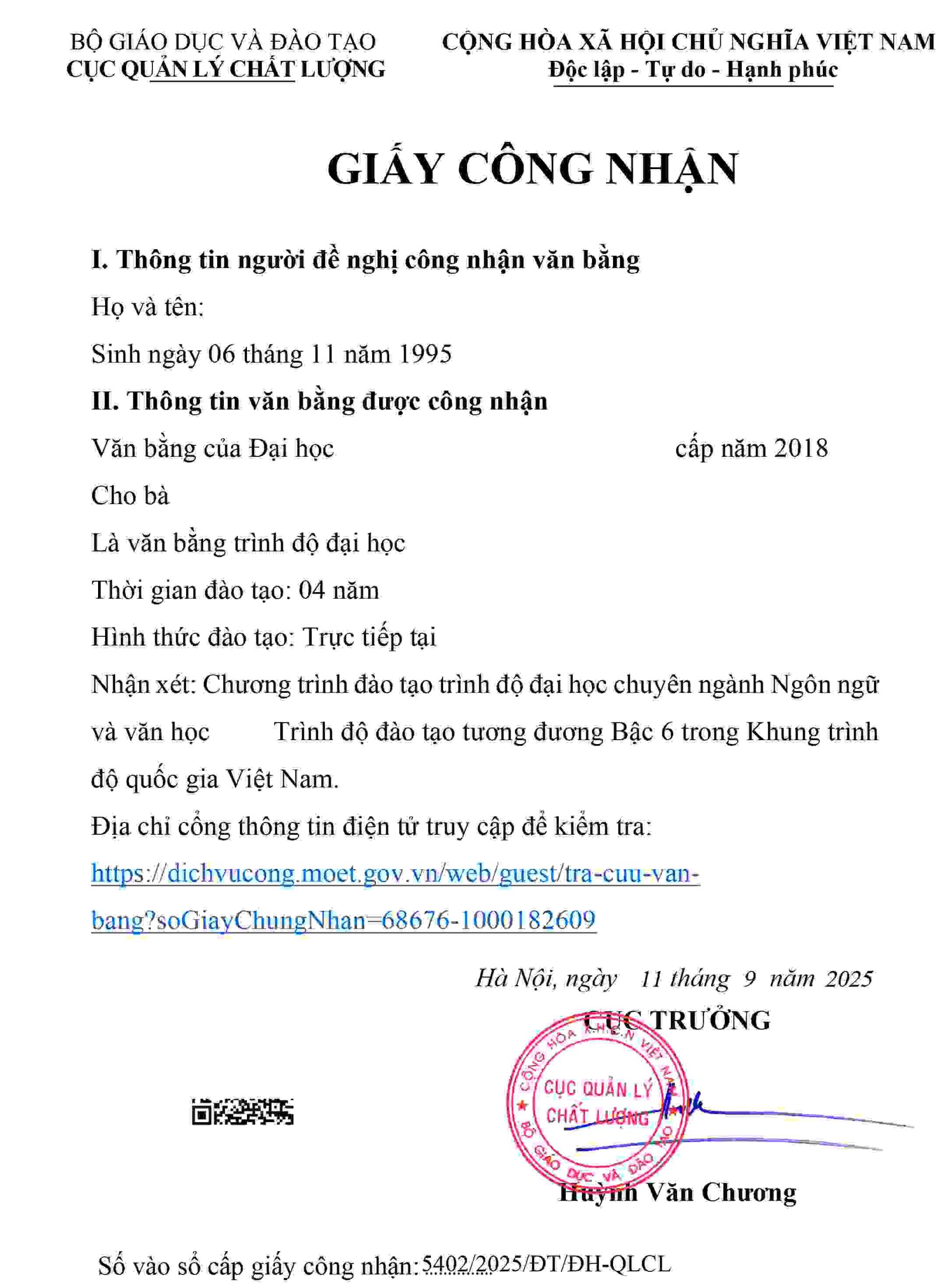
The recognition result is recorded in a recognition certificate using the forms in Appendices II and III of the Circular. If the qualification does not satisfy the recognition requirements, or if sufficient verification grounds remain unavailable after the prescribed period, the competent authority must provide the applicant with a written response.
If the equivalence between the qualification and a level in the Vietnam National Qualifications Framework cannot be determined, the competent authority will provide information about and recognize the qualification's value under the education system of the country where the awarding institution is headquartered.
The competent authority must maintain a register of recognition certificates containing the holder's full name and date of birth, the name of the awarding institution, mode of study, level equivalent to the Vietnam National Qualifications Framework or level under the institution's home-country education system, and the certificate registration number.
An application commonly includes:
An application form for qualification recognition.
A copy of the qualification and academic transcript, translated into Vietnamese and notarized.
A copy of the applicant's identity card or citizen identification card.
A quality accreditation certificate, if available.
Special cases, such as online study or joint training programs, may require confirmation from the educational institution or additional language-related documents. Certain applications may also require proof of immigration history and an authorization letter for qualification verification.
For bachelor's, master's, doctoral, and equivalent qualifications, recognition falls under the authority of the Quality Management Department of the Ministry of Education and Training. The process is centrally administered and can be tracked online, helping promote transparency and consistency nationwide.
The Director General of the Quality Management Department under the Ministry of Education and Training recognizes bachelor's, master's, doctoral, and equivalent qualifications.
The Director of a provincial Department of Education and Training recognizes lower secondary school graduation diplomas, upper secondary school graduation diplomas, and certificates of completion of the general education program.
Article 8 provides for cancellation in the following cases:
If verification shows that the qualification is unlawful or the recognition application contains false information, the recognition result will be cancelled.
The head of the competent recognition authority will issue a decision cancelling the recognition result and withdrawing the recognition certificate, clearly stating the grounds for cancellation and withdrawal.
The decision will be published on the competent authority's website and sent to the qualification holder, the inspection authority that discovered the violation, if any, the holder's employer, if any, and other relevant authorities and organizations.
A recognition certificate is legally valid throughout Vietnam and may be used in applications for employment, admission, salary advancement, civil-service examinations, or further study. It serves as evidence that the qualification is accepted by the Vietnamese State.
The following forms and documents may be required:
Application form for recognition of a qualification issued by a foreign educational institution.
Consent letter authorizing verification of qualification information, where applicable. Contact PNVT for advice.
Application for immigration information, where applicable. Contact PNVT for advice.
After the Quality Management Department receives the application, the applicant will receive a result if the file is valid and all procedural requirements have been followed.
Recognition fees are prescribed by law and may be paid via bank transfer or an electronic wallet. The fee is required for the state authority to process the application and issue the result.
Circular No. 164/2016/TT-BTC dated October 25, 2016, issued by the Minister of Finance, regulates the collection, payment, management, and use of fees for verifying documents used in the recognition of qualifications awarded to Vietnamese citizens by foreign educational institutions.
The fee for verifying and recognizing a qualification awarded to a Vietnamese citizen by a foreign educational institution lawfully operating in Vietnam- including a qualification awarded by a foreign institution under a joint training program between Vietnamese and foreign educational institutions- is VND 250,000 per qualification.
The fee for verifying and recognizing a qualification awarded to a Vietnamese citizen by a lawful foreign educational institution following completion of a training program abroad is VND 500,000 per qualification.
These are government fees. Applicants completing the procedure themselves may also incur costs for certified copies, translation, notarization, document scanning, and postage.
For a full-service qualification recognition package, the service fee may include these expenses. The service provider may also assist in determining which application category applies, identifying required and unnecessary documents, preparing forms, completing the forms correctly, accessing the national public service portal, submitting the online application, and receiving the result. Free consultation is available to help applicants correctly complete the procedure for using a foreign qualification in Vietnam.
An applicant who has lost their citizen identification card and is waiting for a replacement may wonder whether a colleague can use the colleague's VNeID account to submit the foreign qualification recognition application.
Under the applicable procedure, the declaration and online submission must be completed by the applicant through their own VNeID account. Therefore, another person cannot submit the application using their personal account on the applicant's behalf.
The recognition result may be issued as a paper document or an electronic PDF. It states the recognized person's details, the institution's name, field of study, education level, and equivalent value within Vietnam's education system. This is a legal document with long-term validity.
Applicants may access the online public service portal at https://naric.edu.vn to submit an application. The portal allows users to upload documents, pay fees electronically, and track processing status. This is particularly convenient for applicants living far away or currently residing abroad.
The processing time is normally 20 working days when the application is complete. If information must be verified with a foreign institution, processing may take up to 45 working days. Applicants should submit early enough to meet employment or further-study deadlines.
In some cases, the Quality Management Department may request verification through a Vietnamese embassy or the foreign educational institution. This is intended to confirm that the qualification is genuine. If doubts arise, the competent authority may contact the institution directly for comparison and verification.
Bachelor's, master's, and doctoral qualifications may require closer examination of the training program. Additional documents, such as a thesis or dissertation outline or summary, may be requested to assess equivalence with Vietnamese standards. This step is important for maintaining the quality of human resources.
Various service providers assist people who are busy or unfamiliar with administrative procedures. They may translate and notarize qualifications, prepare applications using current forms, submit applications through the NARIC portal, and monitor results. Such support can save time and reduce the risk of errors.
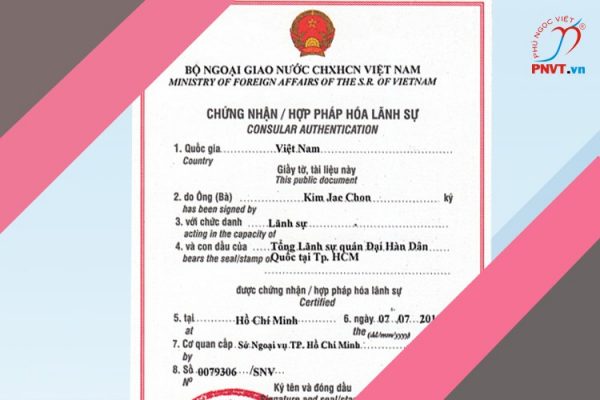
Reputable providers may assist with notarized translation, consular legalization where required, and online submission. This can be useful for applicants who are abroad or unfamiliar with Vietnamese administrative procedures.
Quality accreditation is an important consideration in the recognition process. If the educational institution or program does not satisfy applicable accreditation or authorization requirements, recognition may be refused. Prospective international students should therefore check whether an institution is officially recognized in its country before enrolling.
In addition to online submission, applicants may pay fees through the public service portal. The system can send email notifications, provide application-status tracking, and allow users to download electronic results, reducing travel and waiting time.
Foreign qualification recognition is currently governed primarily by Circular No. 13/2021/TT-BGDDT. This legal instrument specifies recognition conditions, application documents, competent authorities, and procedures.
Other related legal documents include:
Decree No. 86/2018/ND-CP on foreign cooperation and investment in education.
Circular No. 164/2016/TT-BTC on fees for foreign qualification recognition.
Decision No. 2761/QD-BGDDT on the database and principles for qualification recognition.
Circular No. 07/2024/TT-BGDDT updating procedures related to foreign qualification recognition.
Readers should consult the detailed timeline of legal documents and related articles on foreign qualification recognition procedures.
Common errors include missing notarized translations, missing supporting confirmations, incorrect file formats, and inaccurate personal information. Carefully reviewing the application before submission can reduce the risk of it being returned.
Recognition applications vary significantly, and each case may require different evidence to verify a qualification. For example, a person who recently graduated abroad may have the qualification, transcript, and passport but still lack sufficient evidence for verification. The Quality Management Department may then request additional documents, such as electronic flight tickets, immigration records, or other evidence relating to the applicant's period abroad.
Required verification evidence depends on the circumstances no two cases are necessarily identical. In complex cases, the Quality Management Department may request that paper documents be sent by post for examination after the online application has been submitted.
Applicants who are unfamiliar with online procedures, lack time to process the file, or are uncertain about the requirements should seek guidance from the Quality Management Department or consult a suitable advisory service.
Applicants often ask about processing times, the value of a qualification after recognition, whether online qualifications are eligible, and which documents are required for a joint training program. Further information is available through the NARIC portal.
For prompt assistance, use one of the following channels:
User support hotline: +84243 868 4996 - extension 4
Email: cnvb@moet.edu.vn
Recognition of a foreign qualification is an important step in ensuring that it has legal value in Vietnam. Preparing a complete application and following the correct procedure can save time and prevent the file from being returned. Applicants who need assistance may use consultation and translation services to complete the process accurately and efficiently.
For free consultation regarding foreign qualification recognition procedures, call +84 936 784 560.
Featured Products & Services
*YOU MAY ALSO LIKE
Address: 217/2A1 Xo Viet Nghe Tinh Street, Quarter 62, Gia Dinh Ward, Ho Chi Minh City, Vietnam
Hotline: +84 983 158 979
Email: pnvtvn@gmail.com
24H EXPRESS TRANSLATION
►►► A trusted partner for interpretation, certified translation, consular certification, and consular legalisation of documents and dossiers for FDI enterprises, representative offices, multinational corporations in Vietnam, as well as Vietnamese citizens and foreign nationals living and working in Vietnam.
24H Express Translation Household Business
Address: 217/2A1 Xo Viet Nghe Tinh Street, Quarter 62, Gia Dinh Ward, Ho Chi Minh City, Vietnam
Hotline: +84 983 158 979
Email: pnvtvn@gmail.com
24H Express Translation Household Business
Địa chỉ: 217/2A1 Xo Viet Nghe Tinh Street, Quarter 62, Gia Dinh Ward, Ho Chi Minh City, Vietnam
Business Registration License No. 092078008667 - Issued by the Department of Planning and Investment of Ho Chi Minh City
Responsible for content: Mr. Sang
@ Copyright by 24H Express Translation Household Business. Designed by Vietnam Yellow Pages.